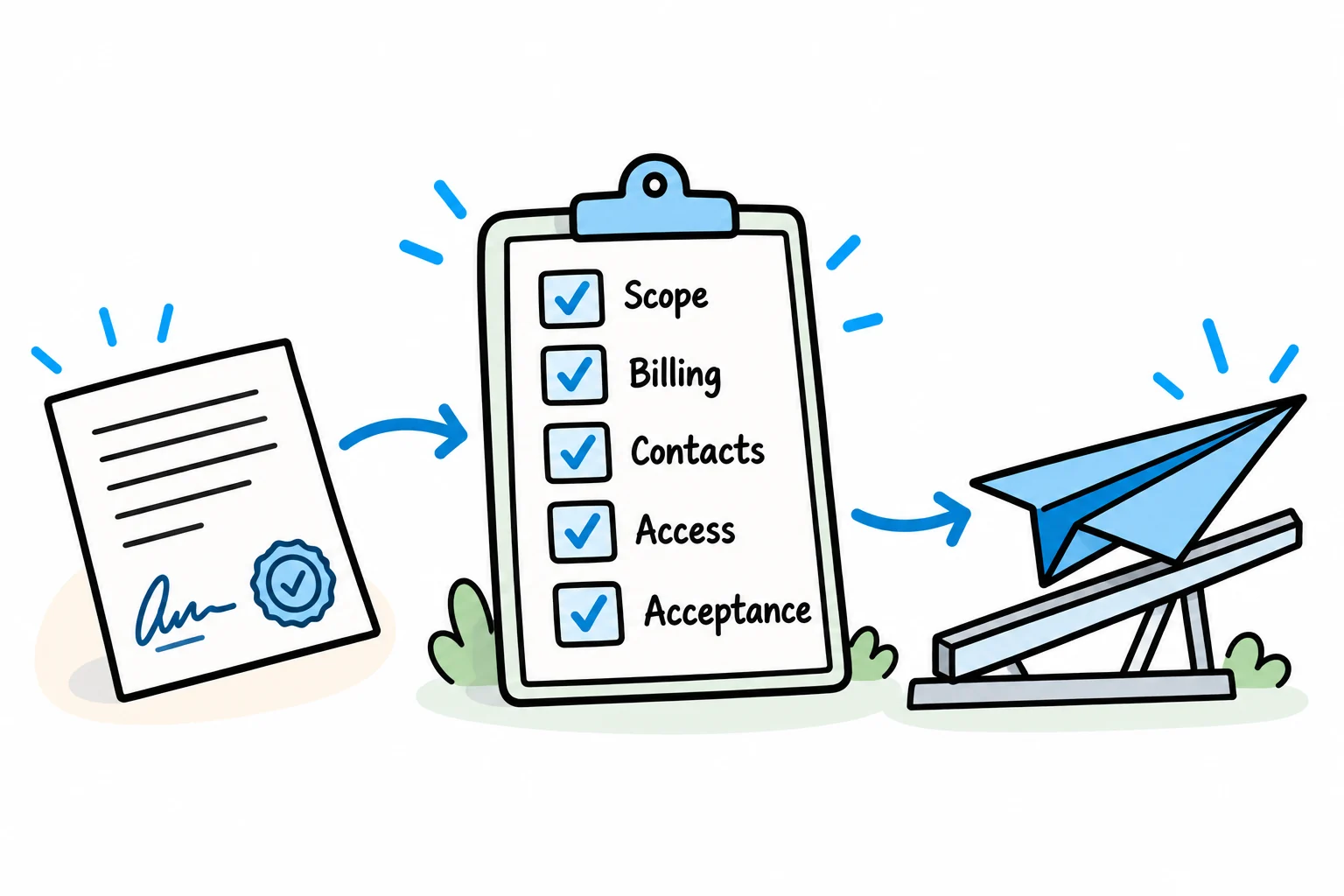
Customer onboarding automation should help a new client become ready for delivery. Define that readiness first, then connect the information collection, checks and internal handoffs needed to reach it.
A signed agreement is one milestone. Delivery may still need verified contacts, an agreed scope, billing details or authorised access to a system. Automating welcome messages while those dependencies remain unclear will leave the underlying chasing in place.
Making the process easier can involve clearer requests, better ownership and fewer repeated checks, alongside any automation.
Define what ready means
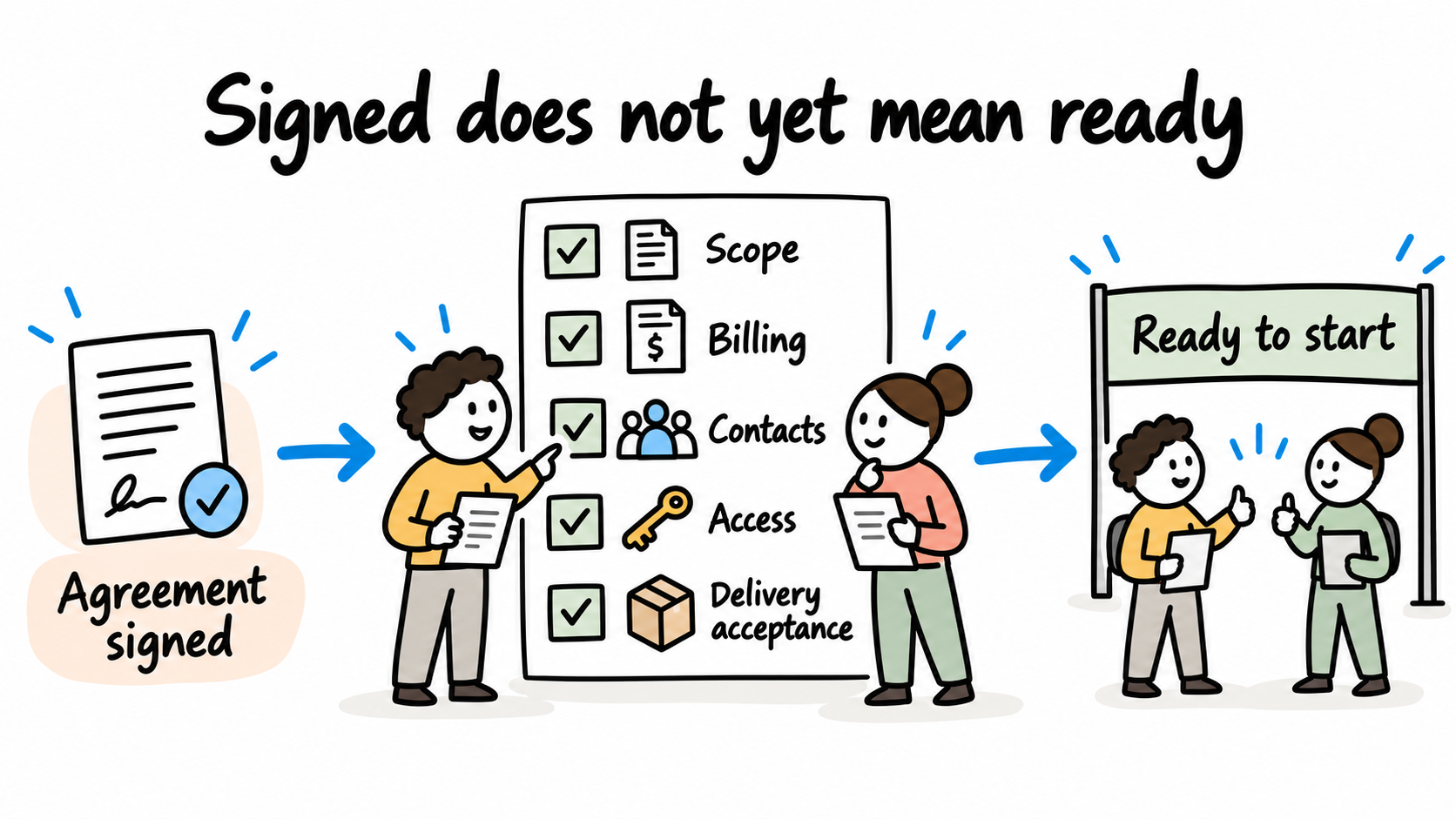
Pick the service you are onboarding, because readiness varies with the work. Ask the receiving team what it needs to accept responsibility for delivery and what can safely arrive later.
Separate required information from optional preferences. Collecting everything you might someday use increases the work for the client and the team checking it. Record why each required item is needed and who accepts it.
Name one readiness owner. Other people can complete checks, but someone needs authority to say that the handoff is complete or that a specific outstanding item prevents it.
Map one onboarding workflow
Illustrative example: an IT support provider is onboarding a customer for an agreed support service. This is a design example, not a client engagement or a universal checklist.
| Readiness condition | Responsible role | Completion evidence |
|---|---|---|
| Service scope and start conditions agreed | Account owner | Accepted agreement and current scope reference |
| Customer and billing records confirmed | Finance contact | Correct billing entity and linked customer records |
| Support contacts and escalation route agreed | Service coordinator | Approved contact list and responsibilities |
| Required system access established | Authorised technical owner | Access verified through the agreed secure process |
| Delivery team accepts the handoff | Support lead | Readiness decision recorded against the current scope |
Use the readiness and ownership worksheet to adapt these conditions. Your service may need different checks. Industry-specific requirements need their own review rather than being assumed from this general example.
Use one request reference across the handoff
Create an onboarding reference linked to the agreed customer and service. The request should show which information is outstanding, who owns the next action and what has already been accepted.
Avoid asking the client to provide the same information in several forms. Where systems already hold an approved value, reuse it under an agreed ownership rule. The data-entry guide explains how to handle matching, corrections and conflicting fields.
Keep credentials and sensitive access material out of ordinary onboarding forms and notification emails. The technical owner should arrange access through the organisation's approved method. The onboarding record needs to show the status and responsible owner, rather than expose the credential itself.
Automate collection and follow-up with clear conditions
A practical sequence is:
- Open the request when the agreed commercial trigger occurs.
- Request only the information required for this service and client situation.
- Validate the submission and assign checks to the responsible roles.
- Remind the owner of a specific outstanding item, using the agreed calendar.
- Present the completed checks to the delivery lead for handoff acceptance.
An acknowledgement confirms receipt. Acceptance confirms that the required check is complete. Keep those states separate so an uploaded document is not automatically treated as a verified document.
Reminders should stop when the relevant item is accepted, waived under policy or no longer needed. A customer should not keep receiving a generic “complete your onboarding” message after providing everything requested.
Make blocked cases visible
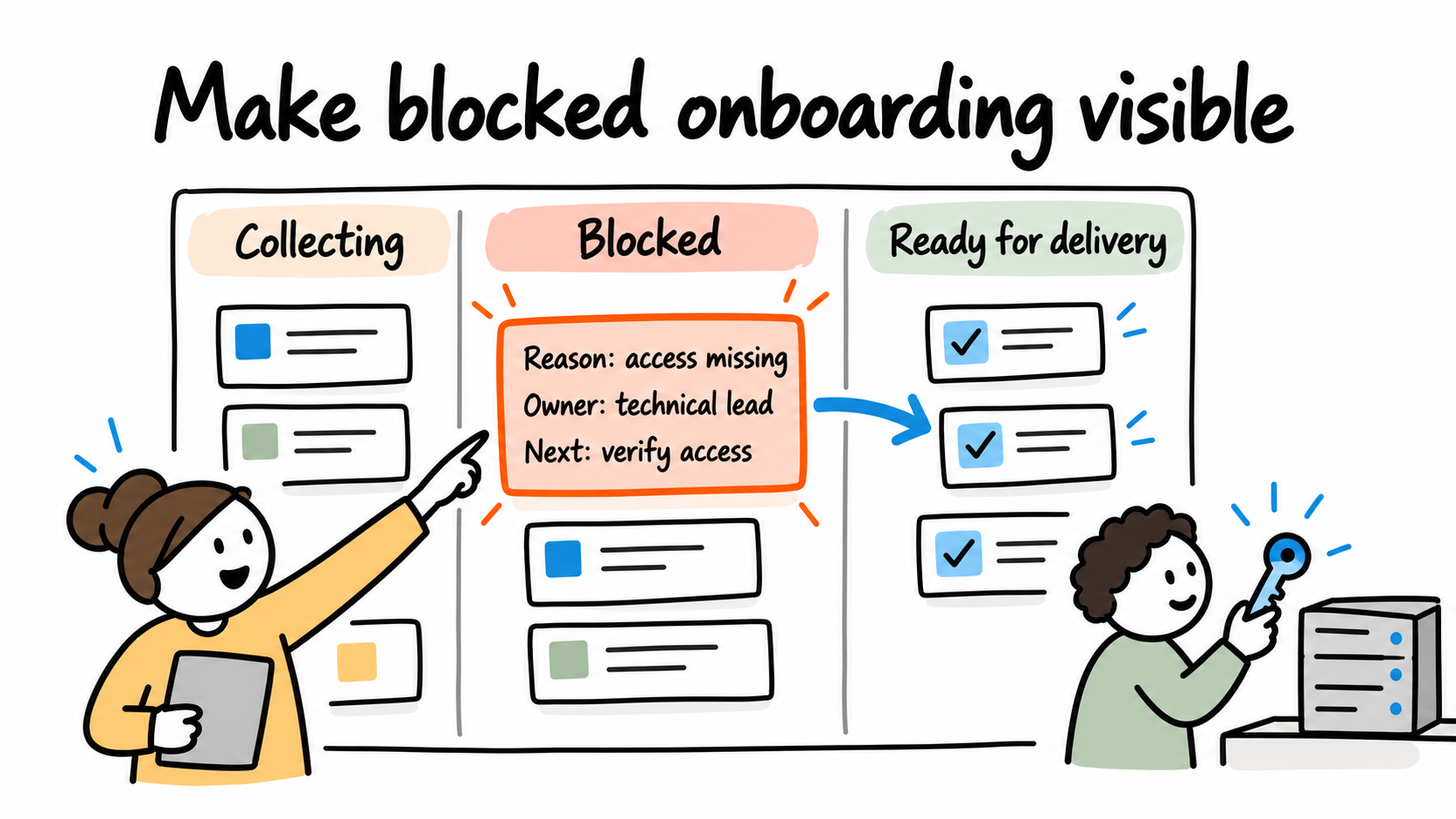
Give each exception a reason and a next action. “Waiting for client” is too broad when the team has not told the client which contact must authorise access.
The exception checklist covers missing information, invalid submissions, duplicates, scope changes and a failed receiving-system update. Its expected outcomes are proposed acceptance criteria, with actual results left for implementation testing.
If the client changes the service scope during onboarding, identify which accepted checks remain valid. New access requirements may need a new technical review. Do not carry old readiness forward merely because the agreement has a new attachment.
If a start date arrives before readiness is confirmed, route that decision to the owner. An automatic calendar event should not silently waive required checks or promise delivery that the team cannot support.
Close the receiving handoff

The delivery team should be able to see the current scope, relevant customer references, accepted checks and any explicitly agreed outstanding items. Record who accepted the handoff and when.
If creating the delivery record fails, retain a visible incomplete state and reconcile the outcome before retrying. Repeated triggers should refer to the same intended setup rather than create additional customer projects or support accounts.
Keep ownership clear after onboarding closes. A later change to the billing entity or authorised contacts needs a maintenance process; it should not reopen every completed task without a reason.
Measure readiness and repeat work
Track the elapsed time from the agreed trigger to delivery acceptance. Break it into time awaiting client input, internal checks and the final handoff. Measure how many submissions are returned for correction and how much manual chasing remains.
Review open and stalled onboardings as well as completed ones. If the slowest cases stay open, the average of completed cases will tell an incomplete story. The bottleneck guide provides a method for that investigation.
Improve the handoff causing the most chasing
We help make onboarding easier for clients and the teams receiving their work. We examine a real onboarding journey, identify repeated requests and unclear handoffs, and agree what readiness means with the people responsible for delivery.
We can introduce the revised process, configure information collection or build the required connections, then test the handoff and establish ownership. Bring one service, its onboarding checklist and a recent case that needed repeated follow-up.
See how we improve onboarding handoffs, or explore our broader business improvement and solution delivery services.
Discuss your customer onboarding workflow with Solvero.
About the author
Jateen Narsai is an IT professional with over 15 years’ experience in business and systems analysis, process improvement and software solution design. His work includes customer onboarding, approval workflows and reporting automation. He works across requirements, solution documentation, testing and implementation support, with a focus on reducing manual effort and making systems easier to use.